Showing posts with label visible. Show all posts

Thursday, 1 February 2018

Super blue moon

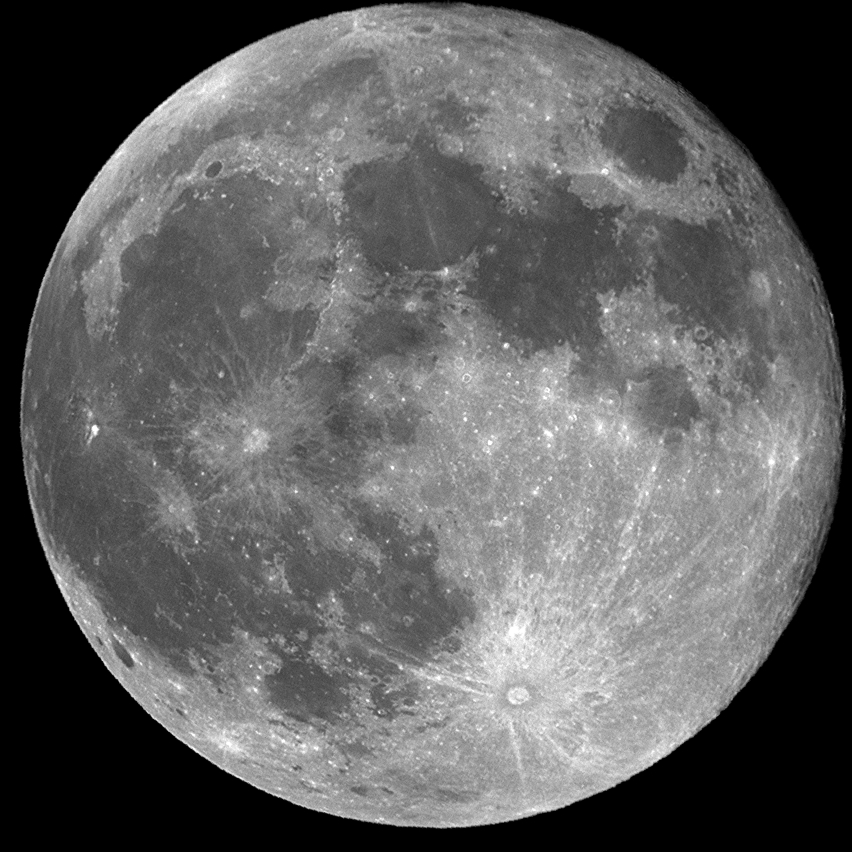
On Jan 31st we observed the full Moon from ESAC (European Space Astronomy Center). This moon was special and widely announced in the media, as it was a blue moon (second of the month), a super moon (at perigee) and a blood moon (eclipse). Unfortunately the eclipse was not visible from Madrid.

Super blue Moon, 31 Jan 2018, from ESAC
So we modified the day-time CESAR solar telescopes set-up such that we could follow the Moon. It was also an important observation, as we succeeded in the first live streaming with the telescopes.

The telescope is the top one (visible light). Filter was removed.

Monday, 22 April 2013

ISS transits the Sun

This white-light image shows the International Space Station transiting the Sun on 20 April 2013, at 17h 35min 32sec. It was captured from the Valmayor reservoir, in Valdemorillo, Madrid, Spain. The active sunspot group number 1726 is visible in the center of the image.

ISS crossing the Sun: frame stacking

The ISS crossed the limb of the Sun in ~1.2sec. The image was taken with a Canon EOS 500 in video mode (25fps, full HD) through a Messier R102 Optical tube with a Baader solar filter. A Coronado SolarMaxII 90 BF30, in piggyback, also recorded the transit. H-alpha images are still being processed.


ISS transit, movie in normal speed


ISS transit, movie in 4x slow motion


The observing team
Friday, 9 March 2012

The active Sun Spot group AR1429

The Sun Spot group AR1429 is a very active sun region that has produced recently two major solar flares with coronal mass ejections: the first one was an X1-class on March 5th 04:13UTC, and the second, even more powerful, an X5-class on March 7th at 00:28 UTC.
Several spacecraft have been affected by the heavy radiation and unleashed wave of solar plasma and energetic particles. By example, the Star Tracker units of the probe Venus Express were blinded for 2 days due to the harsh plasma environment in the aftermath of the CME cloud shock wave.

The next images, taken from ESAC on March 10th, 2012, show the Sun in visible and H-alpha, highlighting the AR1429.

AR1429 sunspot group in visible light. Stacked sequence with a Phillips ToUcam webcam, and a Celestron C8" NGT scope with Baader filter.
Visible light. Canon 550D image with a Celestron C8" NGT scope with Baader filter.
H-alpha image. Canon 550D image with a Coronado Solarmax 70. Limb and disk are processed separately and merged into the final image.

The telescope set-up: Coronado Solarmax 70, Celestron Advanced GT mount, Phillips ToUcam webcam.

Sunday, 23 October 2011

Visible sunspots


The following mosaic was acquired on 14 October 2011 from ESAC with Michel's Celestron newtonian (1m focal, 20cm aperture) and a Baader film filter. Several sunspots groups (1314, 1316, 1317 and 1319) are visible in the image. Another smaller group is seen to the left of group 1319, but it quickly fainted in the following days. We named the group 1319 informally "the Canary Islands", due to the resemblance with the topography of these islands.


This other image was taken in H-alpha with the Solarmax Coronado and shows several dark filaments, along with the sunspots. This image can be compared with images on previous days (check this previous blog entry).

This last animation shows the position of the sunspots and other features in both visible and H-alpha wavelengths.