Showing posts with label Flare. Show all posts

Thursday, 20 July 2017

Iridium flare, 3rd July 2017

Iridium flare captured on July 3rd.


The video is a sequence of 20 frames with 1sec exposure. The total duration of the satellite visible to the naked eye was ~40 seconds, but the flash has a rapid increase and decrease in brightness at the center of the flare, of a few seconds. It was so bright (magnitude -7.4) that you can clearly see its reflection on the lamp post on the top left. Another Iridium post can be found here.


Iridium 11 flare: stacked images

Iridium 11 flare and other celestial objects for reference


Iridium flares are one of the most surprising events visible to the eye in the night sky. They are extremely bright, more than the planets and night stars. Only the Moon is brighter. Unfortunately these flares will not happen for much longer. The old Iridium satellite constellation is being replaced by a more advanced generation, Iridium Next, but those will not develop such intense flares. 

Friday, 9 March 2012

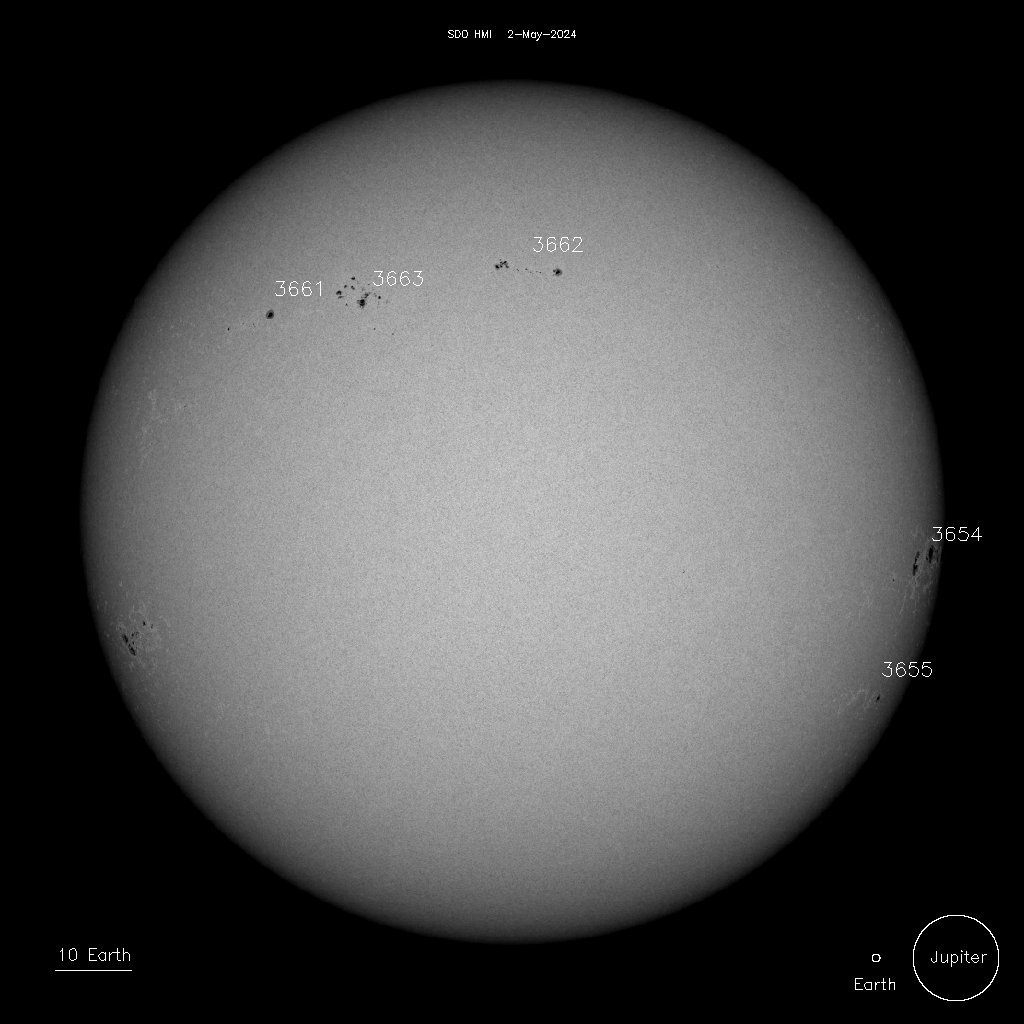
The active Sun Spot group AR1429

The Sun Spot group AR1429 is a very active sun region that has produced recently two major solar flares with coronal mass ejections: the first one was an X1-class on March 5th 04:13UTC, and the second, even more powerful, an X5-class on March 7th at 00:28 UTC.
Several spacecraft have been affected by the heavy radiation and unleashed wave of solar plasma and energetic particles. By example, the Star Tracker units of the probe Venus Express were blinded for 2 days due to the harsh plasma environment in the aftermath of the CME cloud shock wave.

The next images, taken from ESAC on March 10th, 2012, show the Sun in visible and H-alpha, highlighting the AR1429.

AR1429 sunspot group in visible light. Stacked sequence with a Phillips ToUcam webcam, and a Celestron C8" NGT scope with Baader filter.
Visible light. Canon 550D image with a Celestron C8" NGT scope with Baader filter.
H-alpha image. Canon 550D image with a Coronado Solarmax 70. Limb and disk are processed separately and merged into the final image.

The telescope set-up: Coronado Solarmax 70, Celestron Advanced GT mount, Phillips ToUcam webcam.

Tuesday, 4 October 2011

Sunspot Group no.1302, 22 Sep 2011


Hydrogen Alpha image sequence of the sunspot group 1302 and the prominence associated with the X1.4 class solar flare which peaked around 11:00 UTC on September 22nd, 2011.


The images have been captured from ESAC, with a Coronado Solarmax 70 Telescope.

Time coverage: 11:07 UTC - 14:40 UTC
Rate: 1 frame/minute

Michel, Leo and Miguel, dismounting the telescope after observation.


Friday, 9 September 2011

Iridium Flare

On 2011-08-05 between 21:30 and 21:32 UTC, I imaged an Iridium flare with a Canon EOS DSLR camera fixed in azimuth an elevation. The track and the change of brightness is very clear in the image.


The flare was produced by Iridium 60 and it achieved magnitude -5 at the location (40.184N,6.305W) in Boada (Salamanca-Spain). Estimated maximum magnitude was -8 at the flare centre located at a distance of 10 km. Central position of the flare in altitude and azimuth was (40, 70(ENE)). I recommend to observe these flares because it is quite impresive event. During few seconds the flare is the brightest element in the sky. Unavoidable to use heavens-above to forecast the flares in your location.