Showing posts with label Moon. Show all posts

Thursday, 1 February 2018

Super blue moon

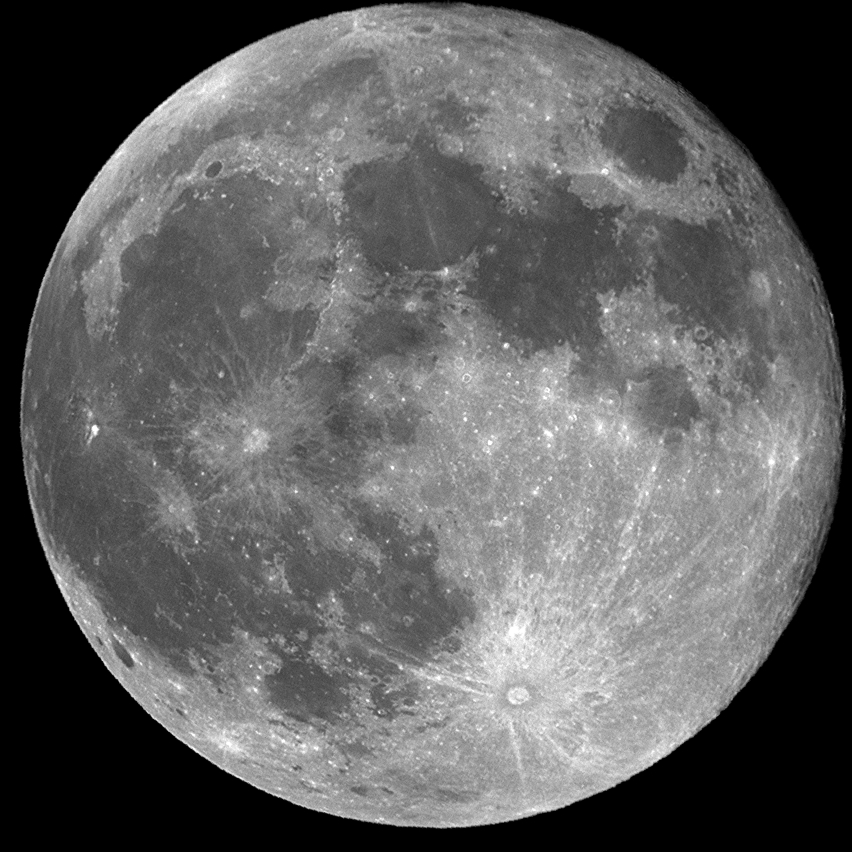
On Jan 31st we observed the full Moon from ESAC (European Space Astronomy Center). This moon was special and widely announced in the media, as it was a blue moon (second of the month), a super moon (at perigee) and a blood moon (eclipse). Unfortunately the eclipse was not visible from Madrid.

Super blue Moon, 31 Jan 2018, from ESAC
So we modified the day-time CESAR solar telescopes set-up such that we could follow the Moon. It was also an important observation, as we succeeded in the first live streaming with the telescopes.

The telescope is the top one (visible light). Filter was removed.

Friday, 2 June 2017

Tiangong - 2

The Chinese space station Tiangong -2 flew across the night sky over a location close to ESAC. The Moon, Jupiter and some clouds complete this night-sky portray.


The Chinese station is a cylindrical module of 10 meters long and 3.3 meters diameter, flying at altitudes around 370km. In this pass, the station came out of shadow at 23:12 CEST on the western sky at 10 deg elevation, crossed the Leo constellation at 62 deg elevation, and got into shadow again at 23:18 in the eastern sky. The apparent magnitude was approximately 1 mag.


The images were taken with a Nikon D3100 with 1sec exposure and a cadence of around 2 seconds.
Friday, 10 February 2017

ISS and the Moon over ESAC

On Saturday 14th 2017 the International Space Station ISS crossed the disk of the Moon as seen from the European Space Astronomy Center, ESAC. 

ISS crosses the Moon video

The image is a superposition of thirteen consecutive frames captured on 14th January at 02:01:14. The phenomena is extremely fast: the ISS took only 0.56 seconds to cross the moon disk! Therefore careful location/timing planning was required to successfully capture it. The ISS was in Earth's shadow, so its black silhouette is clearly seen against the bright background of the Moon surface.


ISS crosses the Moon

ISS-Moon crossings are common, but a crossing from a specific location on Earth is not. The observer, the ISS and the Moon must be precisely aligned. The ISS is the largest man-made object in orbit, spanning the size of a football pitch. Despite its large size, it orbits the Earth at a distance of approximately 400 km, therefore looking tiny to telescope fanatics. Depending on the ISS orbit altitude and the Moon elevation over the horizon, our natural satellite is at least 30-40 times bigger than the man-made station. The geometry is so particular that the ground path where observers can see the event is only a few hundred meters wide. Therefore careful planning of the observation must be performed. The station flies at ~27000km/h therefore the transit takes is a blink of an eye to be complete.
An ESAC group composed of Michel Breitfelner, Manuel Castillo, Abel de Burgos and Miguel Perez Ayucar set up two telescopes with two Canon reflex cameras in the back of the A-building, in the freezing night. The ISS, being in Earth's shadow, cannot be spotted before the crossing, so the observation is done with a clock in hand, and basically in the blind. Everything was right at the precisely expected time. The outcome was awesome: seen a fast dark spot carrying astronauts, flying cross the Moon.